
A dermatology website has one job: show a patient quickly that this practice is the right one, and make it easy to book. To do that job in 2026, the site needs six things:
- Say plainly what the practice treats and how patients pay. Medical, cosmetic, or both. Which insurance plans, or direct pay.
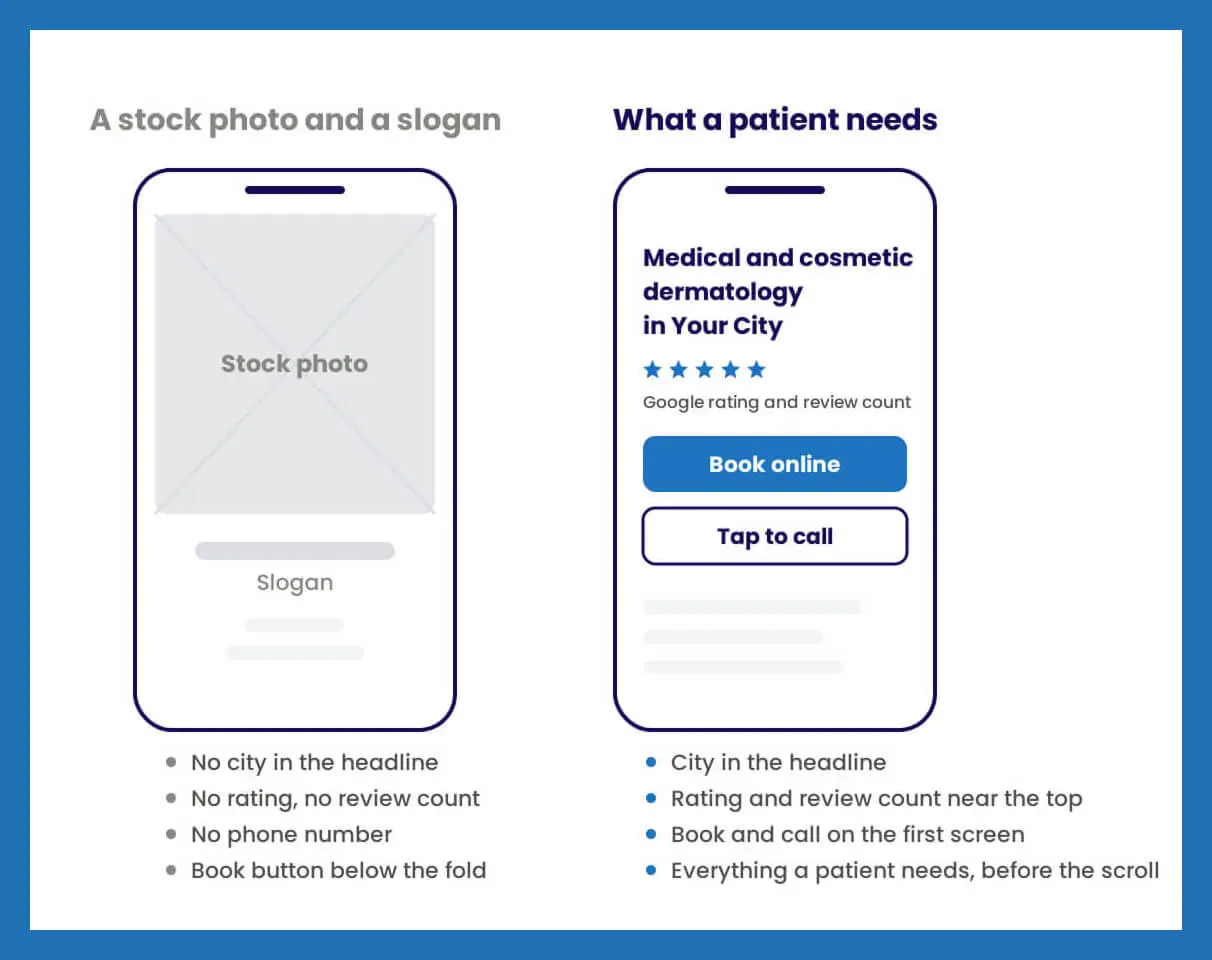
- Show what the practice is, where it is, and how to book or call, all on the first phone screen.
- Name each physician and state board certification, with the certifying board named.
- Give each treatment and each condition its own page, with the facts a patient is deciding on.
- Show before and after photos with signed consent and captions, show dated reviews labeled as selected, and use FDA wording that matches each product’s actual status.
- Load fast, work for every visitor, and keep its name, address, and phone accurate and consistent with the practice’s Google Business Profile.
That is harder than it sounds, because no two dermatology practices are alike. Some are mostly medical, some are mostly cosmetic, and many are both. Some take health insurance and some are direct pay. And Google uses the phone version of a site for indexing and ranking, so all of it has to work on a phone first.
The rest of this post walks through each one, with results from my own client work, in the order of the checks at the end: whether the site can be found, whether it convinces a patient, and whether it converts.
Why a Dermatology Website Is Different
Most practice websites serve one kind of patient. A dermatology website serves two. Medical patients usually arrive with a condition they want treated and a question about insurance. Cosmetic patients usually arrive comparing treatments, providers, and prices. The site has to serve both without confusing either, and it has to say up front where this practice sits: mostly medical, mostly cosmetic, or both, and whether patients pay through insurance or directly.
Give the medical side and the cosmetic side their own entry points: two clear paths in the main navigation, such as Medical Dermatology and Cosmetic Treatments, each leading to its own family of pages, each with the booking option that fits it. A cosmetic consultation can often be self-scheduled. A medical visit may need insurance details first.
Midlothian Dermatology showed me what that gap costs. The practice was a successful, high-volume medical practice, and its own patients did not know it offered cosmetic care. The work was a full marketing program, brand, advertising, social, and email, built to move the perception from strictly clinical to comprehensive care without alienating the medical base, and the website is where that repositioning lives. Over the engagement, cosmetic revenue grew 40 percent year over year. Booking volume for dermal fillers and neurotoxins doubled. Monthly website visitors grew from 500 to more than 3,500. Botox revenue grew from $53,680 in the first quarter of 2025 to $70,836 in the first quarter of 2026.