
Why Your Beautiful Website Isn’t Ranking on Google
You invested in a beautiful website. The branding is polished. The photography looks great. The design feels like your business. Maybe patients and clients even tell you how much they love it.
But are new people finding it?
This is a problem I see with med spas, wellness and hormone clinics, therapists, chiropractors, cosmetic practices, and other consumer-focused healthcare businesses. The website was designed to make a great impression once someone arrives. It was not necessarily built to help people find it in the first place.
That does not mean your designer did a bad job. Design and search visibility are different disciplines. And it does not necessarily mean you need a new website. Sometimes the beautiful website you already have simply needs the content, SEO, AEO, and technical structure that was never built into it.
Is your website actually bringing you new patients or clients?
A beautiful website can feel successful because people tell you they love it. Your analytics may tell a different story.
Start by looking at where your website traffic actually comes from. What percentage comes from organic search? How much comes from paid search or paid social? How much is direct traffic from people who may already know your business?
Then look at Google Search Console. What are people typing into Google before they reach your website? There is an important difference between someone finding you by searching your business name and someone discovering you while searching for a service, treatment, symptom, or condition.
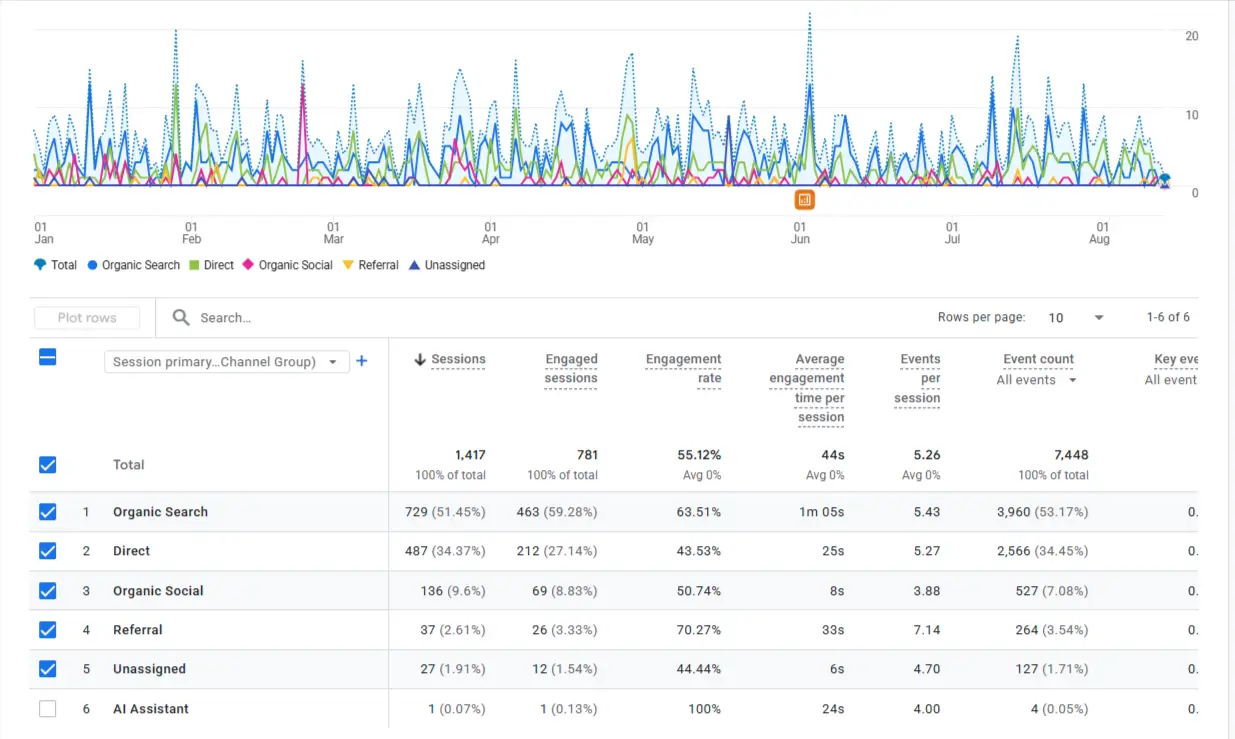
Google Analytics 4 traffic acquisition report, Lopez Chiropractic, Jan 1 to Aug 12, 2026. Alt text: GA4 traffic report showing Organic Search as the top channel with 729 sessions and 63.51 percent engagement, Direct second with 487 sessions, and an AI Assistant channel row with one session.
Here is what that looks like for a real client. At Lopez Chiropractic in Shelby, North Carolina, organic search is the top channel so far in 2026: 729 sessions through mid-August, just over half of all traffic, and organic visitors stay an average of 1 minute 5 seconds per session, compared with 25 seconds for direct visitors (Google Analytics 4, Jan 1 to Aug 12, 2026). The report even shows a new row this year: AI Assistant, with the practice’s first tracked visit from an AI tool.
Getting found when someone Googles your name is not the same as getting found by someone who does not know your name yet. That second group is where much of the opportunity in SEO lives.
If you are a med spa, are people finding you for acne scars, microneedling, Botox, skin tightening, or hair loss? If you run a hormone or wellness clinic, are you appearing when someone searches for help with menopause symptoms, fatigue, weight changes, or hormone therapy? If you are a therapist, are potential clients finding you when they search for anxiety counseling, trauma therapy, or help with panic attacks?
Look at your organic landing pages, too. Which individual pages are actually bringing people into your website from Google? If almost everyone enters through your homepage, your website may be missing the deeper pages that create opportunities to be found.
Paid advertising can be an important part of a strong marketing strategy. I manage it for practices myself. But it should not have to do all the work. Paid advertising buys visibility. SEO builds an asset that can earn visibility. A strong marketing strategy can use both, but your business should not have to buy every visitor it gets.
I have watched that play out over a long horizon. At the Washington Institute of Dermatologic Laser Surgery, where I led marketing from 2011 to 2020, 74.3 percent of the site’s 495,605 users arrived through organic search (Google Analytics, Aug 2011 to Aug 2020). Organic search delivered 368,106 of those users, more than four times direct traffic. The practice never ran Google Ads.
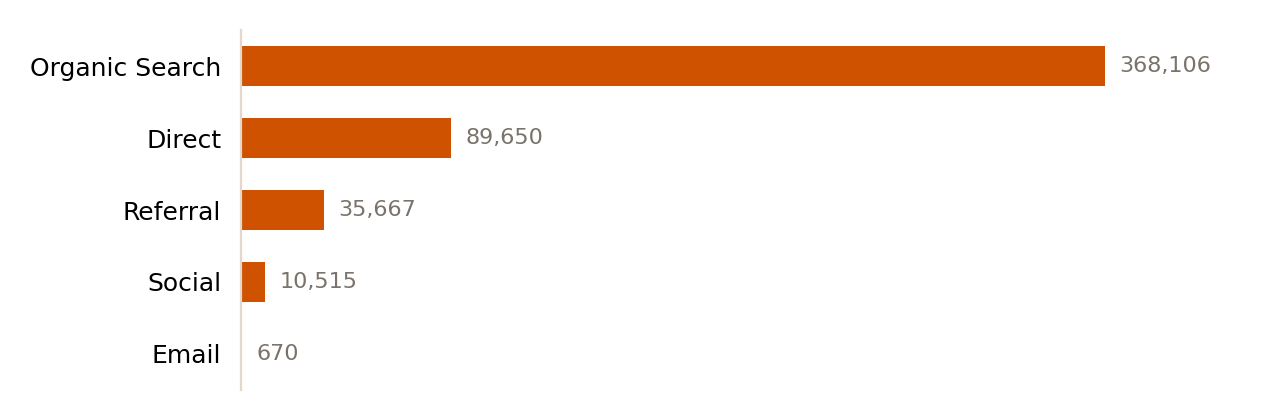
Users by channel, Google Analytics, skinlaser.com, Aug 2011 to Aug 2020. Alt text: Bar chart of users by channel showing Organic Search far ahead at 368,106 users, Direct at 89,650, Referral at 35,667, Social at 10,515, and Email at 670.
Not sure what your website traffic is telling you?
Schedule a consultation to discuss your website, search visibility, and marketing goals. We can look at where you are now and determine the right next steps for improving your organic visibility.
Request a Consultation
Patients find pages, not websites
Nobody searches for your website. They search for an answer. Does Botox help a gummy smile? What helps acne scars? Who treats menopause symptoms near me? Can a chiropractor help sciatica? How do I find a therapist for panic attacks?
Google evaluates individual pages based on how well they answer those searches. AI tools also retrieve and cite individual pages when generating answers. Your website is therefore not one thing competing in one contest. It is a collection of pages, and each page creates another opportunity to be found.
If your website has only a homepage, about page, contact page, and one page listing every service you offer, there are relatively few pages available to compete for all the different things your potential patients or clients search.
A competitor with forty substantive pages has forty opportunities to be relevant. You may have four. And one of yours may primarily be reaching people who already know your name.
“Keep the copy minimal” is terrible SEO advice
Practice owners hear this constantly.
“Nobody reads websites.”
There is some truth here. People do skim websites. But search engines and AI systems read everything, and they need substantive information to understand what you offer, who you help, where you are, and which questions your pages answer. Your patients may skim. The systems that decide whether patients find you do not.
“Keep the copy minimal.”
Nobody wants to arrive at a homepage and encounter an enormous wall of text. But minimal on the surface does not require minimal underneath. Your homepage can remain clean and beautiful while individual service, treatment, condition, provider, and educational pages contain the depth needed to answer real questions. Your website can look minimal without being minimal.
“Let the photography tell the story.”
Good design matters. White space matters. Photography matters. But photography cannot tell Google which conditions you treat, and it cannot be quoted by an AI tool answering a patient’s question. The photos build trust once a patient arrives. The words are what bring the patient to the page.
Beautiful design and substantive content are not opposites. The strongest websites have both.
Your free SEO checklist is missing the most important box
There are hundreds, probably thousands, of free SEO checklists, downloadable guides, webinars, templates, and $99 courses promising to teach business owners how to optimize their own websites. The checklist usually looks something like this:
Keywords? Check. Page title? Check. Meta description? Check. Image alt text? Check.
Congratulations. Your SEO is done.
Except for one problem. Do you actually have the page you need to optimize?
You cannot optimize an acne scar page that does not exist. You cannot rank your hormone clinic’s menopause page if your website does not have one. You cannot optimize a page about anxiety counseling if anxiety is one bullet on a page listing twelve things you treat.
SEO is not simply a collection of settings you apply to a finished website. It starts with understanding what people in your market actually search for and determining what pages your website needs to answer those searches. That is the box most SEO checklists leave out.
Patients search the problem before they know the treatment
This is one of the biggest missed opportunities I see on healthcare and wellness websites. Patients and clients frequently know what is wrong before they know what fixes it.
A woman noticing thinning hair searches hair loss before she knows whether PRP or another treatment is appropriate. Someone bothered by acne scars searches acne scars before deciding on microneedling. A woman struggling with symptoms during perimenopause may search those symptoms before she ever searches hormone therapy. Someone experiencing panic attacks may search for help with panic attacks before knowing which type of therapy or modality might be appropriate. A patient with pain radiating down a leg searches sciatica before deciding whether to see a chiropractor.
That is why strong websites need more than service pages. Service pages reach someone who already knows what they want. A Botox page. A microneedling page. A hormone therapy page.
Condition or concern pages reach someone who knows what is wrong but does not yet know the solution. An acne scars page. A hair loss page. A menopause symptoms page. An anxiety page. A sciatica page.
Those pages can educate the visitor about the concern and then connect them with the services or treatments you offer. They also allow you to meet potential patients and clients much earlier in their decision-making process, before they have already learned the solution from somebody else’s website.
What your website may actually be missing
Adding “more content” is not the strategy. The goal is to build the right content around how people search and make decisions. Depending on your business, that may include:
- Individual pages for important services and treatments
- Condition or concern pages based on the problems patients and clients actually search
- Detailed provider pages that demonstrate credentials, expertise, and care philosophy
- Location pages when a business serves multiple offices or markets
- FAQs based on real questions people ask before booking
- Internal links that connect related conditions, treatments, providers, and locations
- Search-optimized page titles and metadata
- Technical SEO that helps search engines crawl and understand the website
- Structured information and content organization that support AEO and AI search
- Clear conversion paths that make it easy to call, request an appointment, schedule, or inquire
The result should not feel like someone “did SEO” to your website. It should feel like a useful, well-organized website that happens to give both humans and search systems exactly what they need.
Already have a beautiful website? You may not need a new one
I do not believe in replacing good work simply because I did not create it. I have worked with practices that already had excellent branding and beautifully designed websites. The design was not the problem. What was missing was the search infrastructure underneath it.
In those cases, I can research what patients are searching for, identify the missing service and condition pages, write the content, add those pages within the existing design, and complete the SEO, AEO, internal linking, and technical optimization.
That is what I did for one dermatology and aesthetics practice. The original designer had created a beautiful brand and website. I built on that foundation rather than replacing it. Two pages I later wrote for that site earned over half a million organic Google impressions in a year. The design could remain beautiful. The website simply became much deeper underneath it.
And if you already have a web designer you love, keep them. I can research the search opportunity, determine the pages you need, write the finished content, and provide it to your designer for implementation. I can then handle the SEO, AEO, and technical optimization. Good designers and good search strategists do not have to compete with each other. They can do different jobs on the same website.
Building a new website? Don’t choose between design and SEO
If you are planning a new website, you may feel like you have two choices. You can hire the design-first agency with the gorgeous portfolio. Or you can hire the SEO agency talking about keywords, rankings, schema, technical SEO, and AI search. You should not have to choose.
A beautiful website that nobody finds is not doing its job. Neither is a website that ranks but does not represent the quality of your business or persuade the right person to contact you. The strongest websites plan both from the beginning.
Branding and visual design determine how the business is presented. Website architecture determines where your services, treatments, conditions, providers, locations, and patient questions live. SEO helps search engines understand and rank those pages. AEO helps structure information so it can be understood and surfaced in AI-driven search and answer experiences. Conversion strategy helps turn the person who finally reaches the website into an inquiry or appointment.
When those decisions happen together, SEO does not have to be awkwardly added after the website is finished. It is part of the architecture from the beginning. The important question is not whether design or SEO comes first. It is whether someone is thinking about both before the website is built.
SEO and AEO should work with your design, not against it
SEO has a branding problem of its own. People hear “SEO website” and picture something overloaded with text, stuffed with keywords, and designed for Google instead of humans. That is not what good SEO looks like.
You should not be able to look at a website and say, “That’s an SEO website.” You should look at it and think, “That’s a great website.”
The visitor sees the branding, photography, typography, white space, intuitive navigation, and clear next step. Search engines and AI systems see the architecture underneath it: substantive pages, clear relationships between topics, internal links, structured information, technical signals, and useful answers. One website can do both jobs. It should.
What the difference looks like in real numbers
At one dermatology and aesthetics practice, I built the marketing and search foundation on top of an existing professionally designed website. Two service pages I wrote, lip flip and microinfusion, earned more than 540,000 organic Google impressions in 2025. The practice also holds top local rankings for some of its highest-value treatments.
The practice’s annual website visits grew from 4.5K in its launch year to 40.7K in 2025, and organic search was the top traffic channel every full year (Squarespace Analytics, 2020 to 2025).
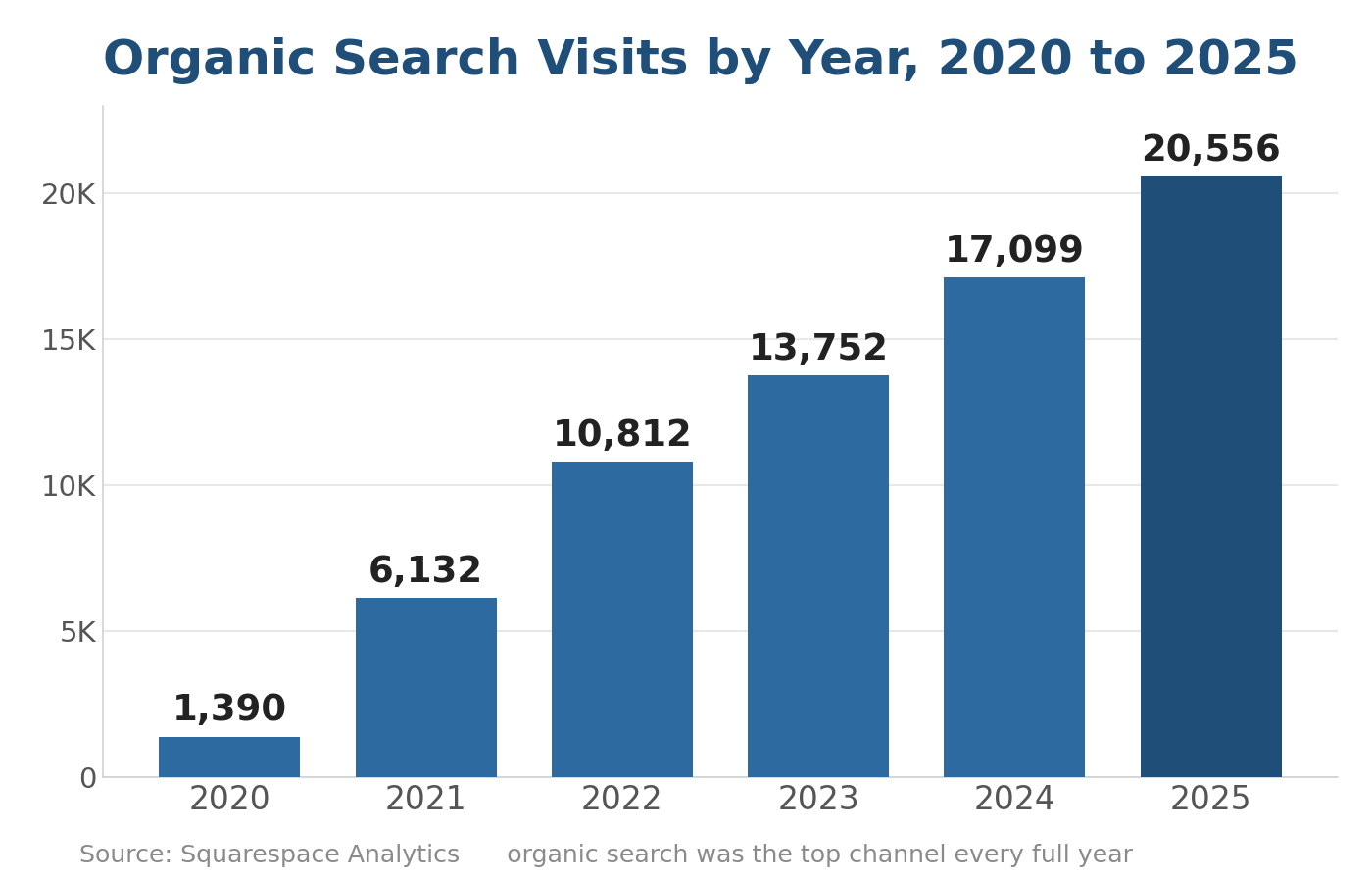
Annual website visits, Squarespace Analytics, 2020 to 2025. 2020 covers the August to December launch period. Alt text: Bar chart of annual website visits growing from 4.5K in 2020 to 40.7K in 2025.
Those pages did not replace the practice’s beautiful design.
They gave Google hundreds of thousands of additional opportunities to put that brand in front of people searching for what the practice offers. That is what substantive content combined with strong SEO can do.
Frequently asked questions
Why is my website not ranking on Google?
There can be many reasons, including technical issues, competition, site authority, content quality, and website structure. One common problem is simply that the website does not have substantive individual pages addressing the services, treatments, conditions, and questions potential patients or clients search for.
Can a beautiful website still be bad for SEO?
Yes. A website can have excellent branding and design while having very little search visibility. Design and SEO solve different problems. Strong websites combine both.
Do I need a separate page for every service?
Not necessarily every minor service, but important services and treatments generally need enough dedicated content for potential patients or clients and search engines to understand them. Keyword research and search behavior should help determine which pages are warranted.
What is the difference between a service page and a condition page?
A service page is written for someone who already knows the service or treatment they are considering. A condition or concern page is for someone searching the problem they want solved. The condition page can then introduce the appropriate services you offer.
Will adding SEO content make my website look cluttered?
It should not. Most of this content lives deeper within the website, not on the homepage. A website can maintain a clean, visually sophisticated design while containing substantial information underneath it.
Can you improve my SEO without redesigning my website?
Often, yes. If the existing design and technical foundation are strong, I can add the missing content and search structure while preserving the website you already have. If there are larger problems with the website itself, I will tell you that too.
Can you work with my existing web designer?
Yes. I can research and plan the content, write the pages, develop the SEO and AEO strategy, and provide the finished material to your existing designer for implementation. I can also handle the technical search optimization.
What is AEO?
Answer engine optimization, or AEO, focuses on making your content easy for AI-powered search and answer systems to understand, retrieve, and use when responding to questions. It complements traditional SEO rather than replacing it.
How do I know whether I need more content or a new website?
Start with the foundation. If the website is fast, mobile-friendly, easy to navigate, technically sound, and represents your brand well, adding the missing content and search infrastructure may be enough. If the website has larger problems with design, structure, usability, performance, or conversion, a rebuild may make more sense.
You don’t have to choose between beautiful and findable
Your website should represent the quality of your business when someone arrives.
It should also give people who have never heard of you a way to find it.
Sometimes that means adding the service and condition content, SEO, AEO, and technical structure missing from an otherwise excellent website. Sometimes it means working alongside the designer you already trust. And sometimes the website itself needs to be rebuilt so design, content, search, and conversion can work together from the beginning.
The right answer depends on what is actually wrong.
If you love your website but are not getting the organic visibility you expected, or you are planning a new website and do not want to choose between great design and strong SEO and AEO, schedule a consultation to discuss your website and what it needs to perform better in search.

 How I can Support your growth