

Answer Engine Optimization (AEO) is the practice of structuring your website so AI tools like ChatGPT, Google AI Overviews, and Perplexity can read it, trust it, and cite your practice as the answer to a patient’s question. Traditional medical SEO gets your page ranked in a list of links. AEO gets your practice named in the answer itself.
This guide explains what that means for a medical practice in plain terms: why patient search has changed, what AI engines actually look for in health content, the six strategies that matter, how to check your own site today, and what AEO honestly cannot do. Every principle in it comes with a real example from my own client work, with numbers and sources, because I would rather show you the thing working than ask you to take my word for it.
How AI changed the way patients find doctors
Patients used to type a few words into Google and scan ten links. Now a growing share of them ask a question in full sentences and get an answer back, with a short list of recommended sources. The shift is measurable. Google’s AI Overviews now appear in roughly half of all searches. ChatGPT reaches hundreds of millions of people every week, by OpenAI’s own count. And Gartner projects traditional search volume will fall 25 percent as AI assistants take over the question-asking.
For a practice owner, the practical meaning is this: your next patient may never see a results page. She asks an assistant “who does Sofwave well near me” or “what should I look for in a concierge doctor,” and the assistant answers before your website ever loads. If your site cannot be read and verified by that assistant, you are absent at the exact moment she is deciding.
What AI engines look for in health content
AI engines do not treat all topics equally. Health falls under what Google calls YMYL, Your Money or Your Life, the category where wrong information causes real harm, so the trust bar is higher than for almost anything else. In practice, the engines reward what the industry calls E-E-A-T: Experience, Expertise, Authoritativeness, and Trustworthiness.
For a medical practice, that translates to a short list. Content written or reviewed by credentialed people, with the credentials visible. Claims that are accurate, specific, and current. A practice identity that is consistent everywhere it appears. And pages structured so a machine can find the answer without guessing. The six strategies below are how you build each of those, and none of them is a trick. Everything that makes a page citable by an AI also makes it more trustworthy to the patient reading it.
The 6 AEO strategies that matter for medical practices
Strategy 1: Lead with the answer, everywhere
AI engines read the first sentence or two of a section to decide whether it answers a question. If those first sentences do not answer the question, the engine picks a competitor’s page that does. The fix: start every page and every section with a direct answer to a real patient question. Then explain.
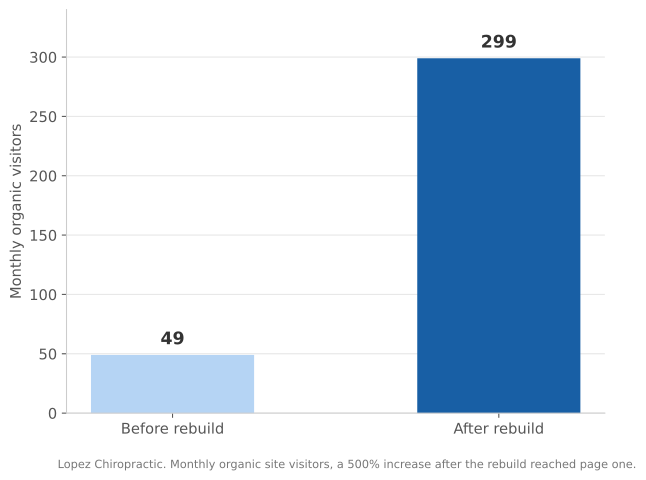
When I rebuilt the website for Lopez Chiropractic, a chiropractic practice in Shelby, North Carolina, I put an FAQ section on every page, each question answered plainly in its first sentence, the way a patient would actually ask it. The practice had been buried on page four to six of Google on a DIY site. After the rebuild reached the top of page one, monthly organic visitors grew from 49 to 299.
Strategy 2: Depth per page beats volume of pages
A common instinct is to publish more pages. The better instinct is to make each page the most complete answer available for one specific question or treatment. Engines cite the source that settles the question, not the site with the biggest sitemap.
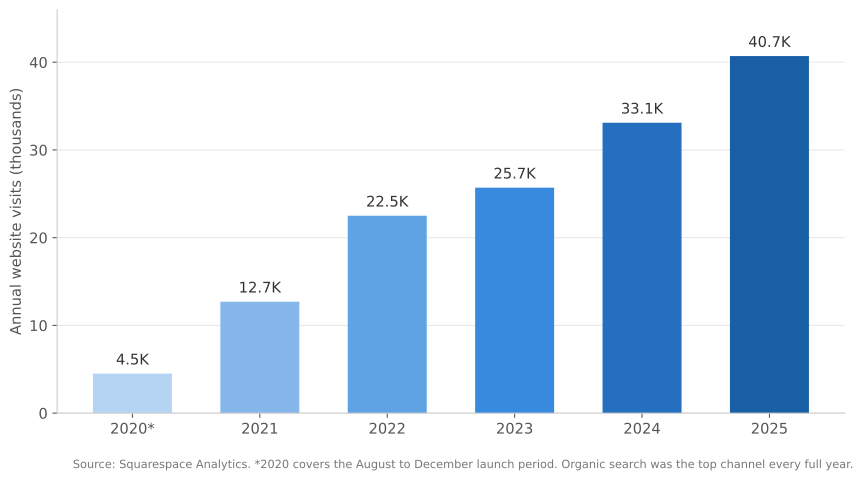
The cleanest evidence I have: at ICON Dermatology & Aesthetics, a dermatology and aesthetics practice in North Bethesda, Maryland, two service pages I wrote, lip flip and microinfusion, earned more than 540,000 organic Google Search impressions in 2025 on their own. Two pages. The same practice ranks #1 in Bethesda for PRX Derm Perfexion, lip filler, Sofwave, and CoolPeel, and organic search became its top traffic channel in its first full year and held that position every year since.
Strategy 3: Make your providers legible
Patients choose people, not buildings, and AI engines have learned to weigh who is behind the content. Credential-rich provider bios, training, board certifications, affiliations, care philosophy, are among the highest-leverage pages on a practice site, and among the most neglected.
Physician authority pages, Golden Gate Concierge Medicine
#2
traffic source on the entire site Four physician bio pages
16.7%
of all monthly site visits Most recent reporting month
648%
monthly sessions growth Ten months post launch
Source: Google Analytics. Each figure from its own period. No figure blends platforms or periods.
At Golden Gate Concierge Medicine, a concierge medical practice in San Francisco, I built detailed authority pages for the practice’s four physicians. Those four bio pages became the #2 traffic source on the entire site, drawing 16.7% of all monthly visits, and physician-name searches now surface the practice across the San Francisco market. For a practice selling a $5,000-per-year membership, the doctor’s page is the deciding page.
Strategy 4: Structure the site the way patients search
Patients do not search for “our services.” They search for the procedure, the symptom, the condition. Your site architecture should map to that: one clear page per high-value procedure or condition, named the way patients name it, linked logically to related pages.
Site restructure, Washington Center for Dentistry
2x
traffic in the first month After the WordPress rebuild
43
procedure pages restructured Mapped to DC patient search
+17%
new users year over year Google Analytics
Source: Google Analytics. Each figure from its own period. No Figure blends platforms or periods.
At the Washington Center for Dentistry, a cosmetic and general dental practice in downtown Washington, DC, I restructured the site so 43 procedure pages, porcelain veneers, dental implants, Invisalign, and the rest, each mapped cleanly to how DC patients actually search. Traffic doubled in the first month after launch. The content largely existed before. The structure is what changed.
Strategy 5: Add the schema layer, because your platform will not
Schema markup is structured data, a machine-readable label that tells engines “this is an FAQ,” “this is a physician,” “this is the practice’s location and hours.” It is one of the strongest citation levers available, and it is the one most practices are missing, for a specific reason: website platforms do not add it for you.
Squarespace, Wix, and similar builders auto-generate only generic basics. Your FAQ content gets no FAQPage markup, your providers get no Physician markup, and your treatments get no service-level labels unless someone adds them page by page. Two rules if you do: the markup must match the visible content exactly, because engines ignore or penalize schema describing things a visitor cannot see, and it must be maintained, because a page edit without a matching schema edit creates a mismatch. I have audited practice sites through Google’s own testing tool that returned “no items detected” on pages full of well-written FAQs. The content was doing its job. The labels were simply never installed.
Strategy 6: Say your name the same way, everywhere
AI engines verify identity by cross-checking. Your practice name, address, phone, providers, and services should read identically on your website, your Google Business Profile, and every directory that lists you. Full names beat abbreviations for the same reason: an engine can connect “Washington Institute of Dermatologic Laser Surgery” to a world-known practice and a famous founder. It can connect an acronym to nothing.
Real practices. Real numbers.
540,000+ organic impressions from two pages. Monthly visitors up from 49 to 299 after one rebuild. 74.3% of nearly half a million users earned without a dollar of ads.
Every figure traces to its own platform and period.
AEO worked before AI existed: nine years of proof
AEO is a new name, but the substance is not new. Engines changed. What they reward did not.
From 2011 to 2020 I ran digital marketing for the Washington Institute of Dermatologic Laser Surgery, a dermatologic laser surgery practice in Washington, DC founded by Dr. Tina Alster. The strategy was what we would now call AEO before the term existed: digitize the credentials, publish more than forty treatment and condition pages each mapped to how patients search, and make the practice’s authority machine-readable. The result, from Google Analytics across the full period: 495,605 users, 74.3% of them arriving through organic search, with not one dollar spent on Google Ads in nine years. Eleven DC treatment searches ranked #1, and the site drove 20 to 51 appointment requests per week by 2019.
I include this because the AI era rewards exactly what that decade rewarded: earned authority, structured clearly. If your marketing has been built on renting visibility through ads or a proprietary website you do not own, AEO is a change of philosophy. If it has been built on owning your visibility, AEO is simply the next step.
Nine years of earned visibility, Washington Institute of Dermatologic Laser Surgery
495,605
users tracked GA, Aug 2011 to Aug 2020
74.3%
of users via organic search No Google Ads, ever
11
DC treatment searches at #1 Rank tracking, July 2019
20 to 51
appointment requests per week Internal weekly reports, 2019
No figure blends platforms or periods.
How to check your site’s AEO today: 5 free tests
You do not need a consultant to find out where you stand. Five checks, all free:
- Google’s rich results test (search.google.com/test/rich-results). Paste a page URL from your site. It lists every piece of structured data Google can find. If your FAQ pages come back “no items detected,” you have found your gap.
- View source. Open a page, view the page source, and search for “application/ld+json.” Whatever appears between those script tags is the complete truth of your schema. If nothing appears, nothing is there.
- Ask the engines your patients’ questions. Open ChatGPT, Perplexity, and Google, and ask what your patients would ask: “best [your specialty] in [your city],” “who does [your signature treatment] near [your area].” Note who gets named and who does not. Screenshot it with the date.
- Google’s PageSpeed Insights (pagespeed.web.dev). Paste a page URL and it grades your loading speed on mobile and desktop. Slow pages lose patients before the content ever matters, and oversized images are the most common cause on practice sites.
- Set a baseline before changing anything. Whatever you measure, bookings, calls, organic visitors, record it the same way before and after any work, in the same tool, over the same kind of period. A before-and-after measured identically is the only version of “it worked” that means anything.
What is AI telling potential patients about your practice?
Find out. We run a full audit for medical practices: speed, structure, schema, indexing, and how AI search reads your site. You get findings you can act on, whether or not we ever work together.

What AEO cannot do
Anyone selling this work owes you the limits as clearly as the pitch.
AEO cannot guarantee citations. Engines choose their sources, and no one controls that choice. It cannot substitute for reputation: a practice with thin reviews and no third-party presence will not out-structure its way into recommendations, because engines lean heavily on sources beyond your own website. It is not one-and-done: engines strongly favor recently updated pages, so content that is not refreshed quarterly loses ground to content that is. And getting found is only half the job. Once a patient lands on your site, the page has to help them act. If there is no clear way to book, if the buttons are hard to find, and if the writing sounds like a medical journal instead of a person, that visitor leaves. No amount of traffic fixes that.
I have seen this up close. I was hired to run ads for a dental practice, and the ads did their job. They brought people to the site. The pages did not do theirs. They were walls of text with no photos and no clear way to book. The deeper problem was that the whole site needed a redesign, and the practice was locked into a contract with the web agency that built it. So I worked the problem from the outside. I audited the site, page speed, oversized images, duplicate URLs, indexing, and handed that agency a list of exactly what was broken. Then I directed the fixes: the teeth whitening and sleep apnea pages rewritten to educate and convert patients, photos placed where they guide the eye, and a booking button you cannot miss.
The practice’s own analytics made the case. Visitors who came in through search engaged with the site at 57 percent. Visitors who came in through paid ads engaged at 3 to 16 percent. Same site, same Google Analytics, same time period. When it was clear the rest of the site could not hold the traffic, I advised the owner to stop the marketing spend until it was fixed, and I ended my own engagement rather than keep billing against a site that leaked.
Images are part of conversion, and the right images depend on the specialty. A cosmetic dentistry or aesthetics page needs before and after photos, because the result is the product. An orthopedic surgeon’s page needs the patient and their story, because the result is a life working again. Stock photos of smiling models do neither job.
The lesson is simple. Writing pages that convert, and showing the proof patients need to see, is part of AEO, not a separate job. Getting named in an AI answer means nothing if the patient clicks through and cannot figure out how to book.
Finally, AEO cannot fix a bad patient experience. It gets your practice named. What happens after the click, and after the visit, is still the practice’s to earn.
Where to start with AEO
If you take one thing from this guide: run the five checks above this week. They cost nothing, they take under an hour, and they turn “should we care about AI search” from a debate into a diagnosis.
And if the diagnosis says you have work to do, that is what I do. I build AEO for independent medical practices, dermatology, aesthetics, dental, chiropractic, concierge medicine, and direct primary care, as a founder-led specialist who has served this industry since 2010. You can read exactly how I work at AEO for Medical Practices.

 How I can Support your growth